
Writing a literature review often feels like the “homework” you have to finish before you get to the “real” research. But if you treat it as a box-ticking exercise, you’re missing the most powerful tool in your shed.
Think of a literature review not as a summary of books, but as joining a high-stakes conversation. You wouldn’t walk into a room of experts and start shouting your opinions without listening to what they’ve been talking about for the last hour, right?
1. It Saves You From “The Ghost of Research Past”
There is nothing more soul-crushing than spending six months on a study only to realize someone else published the exact same findings in 2012.
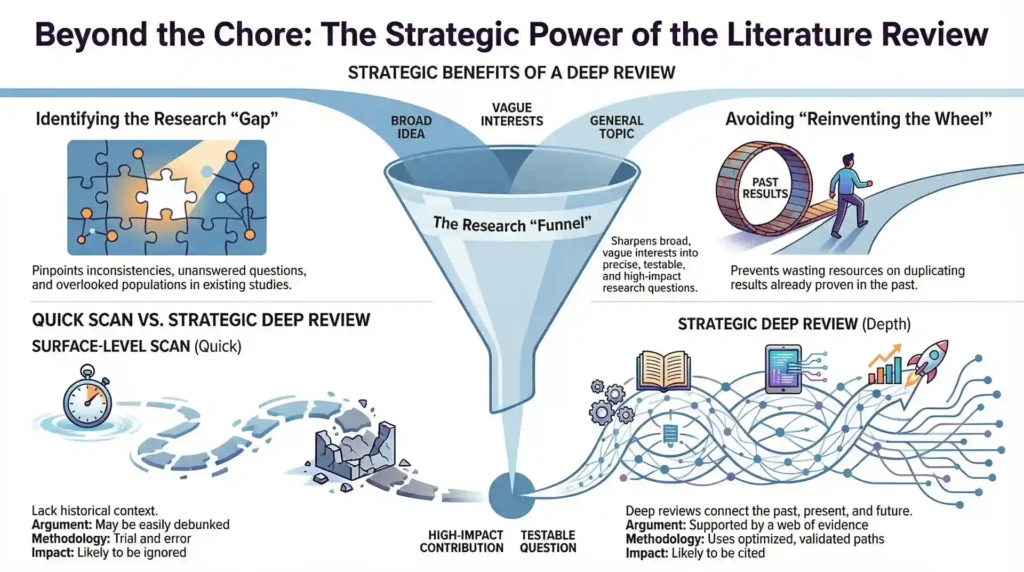
- The “So What?” Factor: A deep dive helps you find the “gap.” You aren’t just repeating what’s been said; you’re finding the one brick missing from the wall.
- Efficiency: You learn from others’ mistakes. If five previous papers say “Method X didn’t work for this,” you just saved yourself a failed experiment.
2. It Builds Your “Street Cred
In the academic world, your citations are your credentials. When you show you’ve read the foundational giants and the newest pre-prints from last week, you’re telling the reader: “I know this world. You can trust my judgment.” > Note: A good review isn’t a shopping list (“X said this, Y said that”). It’s a synthesis. You’re the narrator explaining how all these different voices fit together.
3. It Sharpens Your “Sword” (The Research Question)
Most people start with a research question that is way too broad—like trying to boil the ocean.
- The Funnel Effect: As you read, your focus naturally narrows.
- Precision: You move from “I want to study health” to “I want to study the impact of Vitamin D on urban-dwelling adults over 60 during winter.” That precision only comes from seeing where the current boundaries of knowledge lie.
Why Quality Time Matters: Quick vs. Deep
| If you rush it… | If you take your time… |
| Your paper feels “thin” and unconvincing. | Your argument feels inevitable and solid. |
| You might use outdated or debunked theories. | You use the most robust, modern frameworks. |
| Reviewers will tear your “originality” apart. | Reviewers will respect your mastery of the field. |
4. It Basically Writes Your Discussion Section for You
This is the “secret” advantage. If you do a great literature review, the final section of your paper (the Discussion) becomes a breeze. You just have to say: “Remember Author A? My results actually support their theory,” or “Surprisingly, my findings contradict what Author B suggested.” You aren’t just shouting into the void; you’re talking back to the literature.
The Bottom Lin
The literature review isn’t a barrier to your research—it is the foundation of it. If the foundation is shaky, the whole house falls down the moment a peer reviewer leans on it. Spend the time. Read the extra ten papers. It’s the difference between a forgettable assignment and a contribution that actually moves the needle.